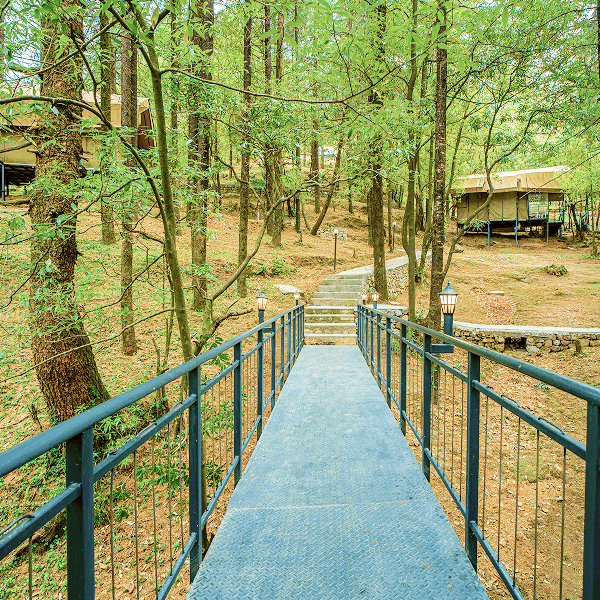
Staying in a Deodar Forest Resort in Mussoorie
What the Trees Actually Change About Your Trip
Filtered light, the scent of resin and a forest full of birds. Here is what it really means to stay in a mature deodar forest in Mussoorie.
What Deodar Cedar Is and Why It Defines the Mussoorie Forest Experience
A deodar forest resort in Mussoorie is a specific thing. It is more than a property with trees in the background. The forest itself shapes the stay. In the older parts of the Mussoorie forest, some deodar cedars stand 30 to 40 metres tall. Their crowns filter light the way stained glass does. This piece covers what that means for you as a guest. It also shows how to find the real thing, rather than a property with three trees in a concrete garden.
What Is Deodar Cedar, and Why Does It Define the Mussoorie Forest Experience?
Cedrus deodara, the deodar cedar, is the main tree of the western Himalaya between 1,500 and 3,200 metres. In Mussoorie it shares the forest with oak, pine, rhododendron and horse chestnut. But it is the cedar that gives the forest here its look and feel.
A mature cedar is a large, grand tree. Look for the drooping branch tips, the blue-green needles and the deeply furrowed bark. Then breathe in the resin in the morning air. All of it is pure cedar. A cedar forest in fog or morning mist looks and feels like no other Indian forest.
If you stay at a property set inside this forest, the trees are not scenery. They are the place itself. Morning light through the canopy changes how every outdoor space feels. And the scent of resin in cool air is the detail many guests remember most from a Mussoorie stay.
Where Is the Best Deodar Forest Cover in Mussoorie?
Deodar forest in and around Mussoorie is found in a few key zones:
- Hathipaon Road and the Cloud's End area: The west end of the ridge has some of the densest, oldest cedar cover left near the town. Properties along Hathipaon Road sit inside or beside this forest. EBC Mussoorie is one of them, on Park Estate. This stretch sees far fewer visitors than Mall Road. It keeps a forest feel that the busy town centre has lost.
- Jabarkhet Nature Reserve (beyond Landour): A private nature reserve past Landour, with nature trails and good birdwatching. Properties near Jabarkhet have its protected forest right on their doorstep.
- Benog, west of the town: Benog Wildlife Sanctuary (also called Mussoorie Wildlife Sanctuary) lies about 11 km from Mussoorie, out past Cloud's End towards Benog Tibba. It protects a tract of deodar and oak forest.
- Chakrata forest zone (90 km from Dehradun): If you want the densest cedar forest, go to Chakrata. Not even the best parts of Mussoorie match its scale. The forest around Chakrata and Deoban, whose name links it to the deodar, is among the finest cedar forest left in the Indian Himalaya.
What Does a Deodar Forest Resort Experience Actually Include?
The best deodar forest resorts near Mussoorie build the stay around the forest itself:
- Morning forest walks: Picture a guided walk through old cedar forest at 7 AM. A naturalist walks with you and points out birds by their calls. It is one of the most distinctive things to do in the hill station. EBC Mussoorie builds this into every stay. Its guided walks run daily from 7 to 9 AM and last 45 to 90 minutes. They follow deodar forest and ridge trail routes. Its rooms, tents and cottages in the forest reflect the same outdoor-first approach.
- Birdwatching in the forest canopy: The cedar forest has its own set of birds. The Himalayan griffon soars overhead. The white-throated laughingthrush, the black-throated tit and several Himalayan flycatchers are common in well-wooded parts of Mussoorie. A property beside old cedar cover will have good birdwatching on its own grounds. EBC has recorded over 50 species on the property and in the forest around it. They include the Blue Whistling Thrush, the Verditer Flycatcher, the Kalij Pheasant and the Himalayan Woodpecker.
- Campfire evenings under the canopy: A campfire in a forest clearing feels nothing like a bonfire at a poolside resort. The evening air cools and the scent of resin is at its strongest. The forest changes the whole mood. At EBC, the bonfire is lit each evening, with blankets. The kitchen serves Garhwali dishes such as kafuli and mandua ki roti.
- The sound of the forest: Most travel writing overlooks this. An old cedar forest at dawn has its own sounds. Wind moves through needled branches. Bird calls carry differently under a high canopy than over open ground. And the quiet is nothing like city silence. Guests who have slept under open sky and then within a forest canopy often describe their sleep in very different ways.
How Do You Tell a Genuine Forest Resort From a Property With a Few Trees?
Properties use the word "forest" loosely. Here is how to check:
- Ask for a satellite or map view of the property and the forest around it
- Ask for photos taken looking out from the room itself, not from a distance
- Ask whether the forest lies inside the property boundary or next to it. Next to it is still good. Claimed but far away is not.
- Read reviews for mentions of forest sounds, birdlife and tree cover
The Ecological Context: Why Forest Resorts Matter Beyond Tourism
Mussoorie has lost a great deal of forest cover to building over the decades. Properties that protect the cedar and oak inside their bounds are doing something that matters for the land. It is about more than good looks.
When you stay at a property that guards its forest, you help support that outcome. It is worth weighing as you choose, alongside the experience itself.
For a guest's view of the forest at a property in the Mussoorie hills, read the Tripoto piece on EBC Mussoorie. It gives a grounded, first-person view of how this place feels from the inside.
The Hotelier India feature on EBC Mussoorie also places the property within the wider shift towards nature-first hospitality in the Mussoorie hills.
Common Questions
Frequently Asked Questions
Everything you need to know before booking a deodar forest resort in Mussoorie.
The deodar cedar is the main Himalayan forest tree between 1,500 and 3,200 metres. Its forest brings filtered light, the scent of resin and a rich bird life. Together, they define the feel of a Mussoorie hill stay.
Hathipaon Road and the Cloud's End area in western Mussoorie have the oldest deodar cover near the town. Chakrata, 90 km from Dehradun, has the densest deodar forest in the wider region.
Yes. Deodar forest supports a rich bird community. On a good morning, a walk with a skilled guide can turn up dozens of species. At EBC, over 50 species have been recorded on the property and in the forest around it.
Most are, but check how rooms are heated before you book a December to February stay. The forest in winter is striking, above all after a snowfall.
Ask for a satellite map view and for photos looking out from the room. Then read reviews that describe the forest itself, not just the facilities.
Not always on a per-night basis. But the best-placed forest properties in Mussoorie do tend to be boutique or premium stays. For guests who value the setting, it is worth it.