Bird Watching Resort in Uttarakhand
A Serious Birder's Guide to the State's Best Stays
Over 650 species across three natural zones. Here is where to stay for the best birding in Uttarakhand, from the Terai to the alpine meadows.
The Best Bird Watching Zones and Their Anchor Resorts
Uttarakhand lies in one of the richest wildlife belts of the Himalaya. The state has recorded over 650 bird species. They range from the Terai grasslands, under 300 metres, to the alpine meadows above 4,000 metres. Few states in northern India match that range within one border. For birders, this makes planning unusual. The question is not whether to come to Uttarakhand. It is which zone to target and which height band to work. It is also which resort puts you in the best morning light, with the least travel to the best habitat. This guide answers those questions one by one.
Three natural zones meet in Uttarakhand. The first is the Terai and Bhabhar, below 500 metres. It has sal forest, tall grass and river flats. Look for the Great Hornbill, Pallas's Fish Eagle and Swamp Francolin. The second is the band of subtropical to temperate forest, from 500 to 2,500 metres. It is the richest zone of all. Oak, rhododendron, deodar and mixed broadleaf forest hold a dense mix of flycatchers, laughingthrushes, minlas, warblers and raptors. Mussoorie, Nainital and Lansdowne all sit in this band. The third is the subalpine and alpine zone, above 2,500 metres. Here you find high-altitude birds such as the Himalayan Monal, the state bird, plus Snow Partridge, Grandala and several rosefinches. In most years you can reach it from May to October. A birder who covers all three zones in one 10-day trip can fairly hope to log 200 to 300 species.
Zone 1: Why bird in Mussoorie and on the Garhwal ridge (1,500 to 2,300 metres)?
Key species: Kalij Pheasant, Hill Partridge, White-throated Laughingthrush, Verditer Flycatcher, Grey-headed Canary-flycatcher, Crested Kingfisher along streams, and many Himalayan warblers
Why it works: The forest runs unbroken along the Mussoorie ridge, above all around the Jabarkhet reserve and Cloud's End. It holds a resident bird community that you can reach without a trek. A morning walk from a well-placed resort can turn up 30 to 40 species before breakfast.
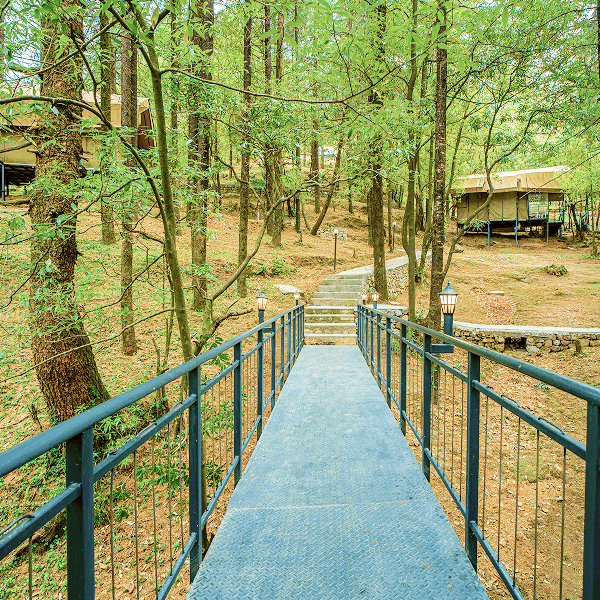
EBC Mussoorie sits in this forested hill zone, at 2,160 metres on Hathipaon Road. Over 50 species have been recorded on the property and in the forest around it. They include the Himalayan Bulbul, Blue Whistling Thrush, Himalayan Woodpecker and White-capped Water Redstart. A guided nature walk runs every morning from 7 to 9 AM and comes with every stay. Our naturalist guides know the local birds by sight and call. That makes it a practical base for birders who want a comfortable room and the forest at the door.
Best months: March to May (migration and breeding), and October to November (clear air after the rains, and winter arrivals)
Zone 2: What makes Corbett and Dhikala (300 to 600 metres) so rich?
Key species: Great Hornbill, Oriental Pied Hornbill, Pallas's Fish Eagle, Crested Serpent Eagle, Brown Fish Owl, Jerdon's Nightjar, Stork-billed Kingfisher, Ruddy Shelduck
Why it works: Jim Corbett National Park is India's oldest national park. It is one of the best places for birds in the country. The Ramganga River in the Dhikala zone draws huge flocks of water birds. The mix of forest and grassland in the Bijrani and Jhirna zones adds more habitat.
Where to stay: Stay in the Corbett buffer, near the Dhangadhi gate or the Bijrani zone. That gives you the best start for early jeep safaris. Choose a property that can arrange safari permits in advance.
Best months: October to June. The Dhikala zone closes for the monsoon, from mid-June to mid-November. Some zones stay open all year.
Zone 3: Why do birders rate Nainital and Sattal (1,200 to 2,100 metres)?
Key species: Sattal may be the richest single birding site in the Kumaon hills. It has seven linked lakes, ringed by oak and pine. You will find kingfishers and broadbills. From March to May, a wide range of warblers pass through.
Why it works: Sattal has drawn birders for decades. Water and forest packed into a small area pull birds together in a way that open forest does not.
Best months: March to May for migration. October to November for winter arrivals.
Zone 4: When should you go to Chopta and the Tungnath meadows (2,700 to 3,500 metres)?
Key species: Himalayan Monal, Blood Pheasant, Snow Partridge, White-rumped Snowfinch, Rufous-breasted Accentor, several rosefinches, and the Lammergeier overhead
Why it works: Chopta is the gateway to the Tungnath meadows. It is one of the best high-altitude birding sites you can reach in the Indian Himalayas. The rhododendron and oak forest below the tree line holds Monal and pheasants in good numbers.
Practical note: Rooms at Chopta are basic. Serious high-altitude birding here means a tent camp, or day trips from Ukhimath or Gopeshwar.
Best months: May to October.
What makes a resort truly good for bird watching?
Not every resort that talks about birding can back it up. A birder-friendly resort has:
- Forest next door, not just forest views: The property should sit in or right beside living habitat. Looking at a forest across a cleared valley is not the same.
- Skilled guides on call: A local guide who knows the birds here by sight and call is worth more than a forest on the map. Ask about the guide and what they know.
- Set up for early starts: Birding peaks in the first two hours after sunrise. That means a 5:30 to 6 AM start. If the kitchen opens at 8 AM and there is no packed early breakfast, the resort is not set up for you.
- Feeders and water: Some well-run birding lodges keep feeding stations and water points on their grounds. These draw birds reliably and save long walks on rest days.
- Little light pollution: For dawn and dusk birds, such as owls and nightjars, a dark property makes a big difference.
Which species can you target in each season in Uttarakhand?
- March to May (pre-monsoon): Most resident birds are breeding. Warblers, flycatchers and raptors are moving up the slopes. This is the best window for overall variety.
- June to September (monsoon): High-altitude birds are at their most active. Thick leaves make birds hard to see. Sattal and Corbett are slower. Chopta and Tungnath are at their best, but landslides can close mountain roads, so check advisories and keep spare days. In Mussoorie, the forest is green, misty and very quiet. It suits slow morning walks close to your room.
- October to November (post-monsoon): Winter visitors arrive from Central Asia. Raptors gather. Clear skies make for better sightings. Corbett reopens zone by zone.
- December to February (winter): Lowland birds and winter migrants lead. Corbett's riverside habitat is excellent. High-altitude sites are cut off. At mid-height sites, the thinner undergrowth makes birds easier to see.
How do you plan the practical side of birding in Uttarakhand?
- Carry a standard field guide. Grimmett, Inskipp and Inskipp cover the whole Indian subcontinent.
- Check eBird hotspot maps for Uttarakhand. They show recent species lists for each site before you go.
- Pack a recorder for calls. It helps in thick forest where you cannot see the bird.
- Use binoculars of at least 8x42 for forest birding, and 10x42 for open ground and high altitude.
- Book Corbett jeep safari permits ahead, through the official Uttarakhand Forest Department portal.
For a feel of the forest around the Mussoorie hills, this Tripoto account of EBC Mussoorie gives useful detail from the ground.
The Hotelier India feature on EBC Mussoorie also shows how the resort makes the forest part of every stay.
Common Questions
Frequently Asked Questions
Everything you need to know before booking a bird watching resort in Uttarakhand.
March to May gives the most variety. October to November is the best window for winter migrants and clear viewing.
Sattal in the Kumaon hills and Jim Corbett National Park give the highest species counts for a single trip. Chopta adds high-altitude birds you will not find elsewhere in the state.
Yes. The forests around Mussoorie, Nainital and Corbett are easy to reach and rich enough for beginners. A local guide makes a big difference.
Some do. At EBC Mussoorie, the guided morning walk with a naturalist is included with every stay. Elsewhere, check the guide's experience and whether there is a charge before you book.
Yes, for the Mussoorie and Corbett zones. Two nights at a forest resort in either zone is rewarding and easy to plan from Delhi NCR. EBC Mussoorie is about 280 km from Delhi, or 5.5 to 6.5 hours by road.
Bring binoculars (8x42 at least) and a field guide. Wear dull, plain outdoor clothes and waterproof shoes. A recorder for calls helps too.