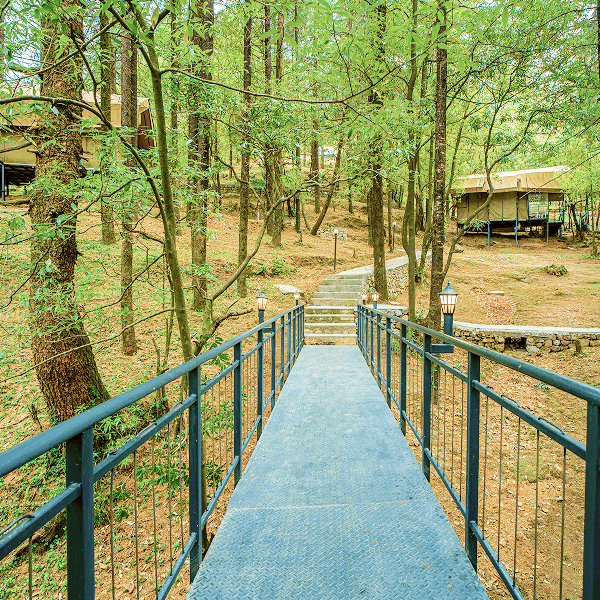
Monsoon Glamping Near Dehradun
What Actually Works and What to Expect Before You Book
Mist in the deodars, waterfalls in full flow and cool evenings by the fire. The monsoon in the hills above Dehradun is special if you choose the right place and plan well.
The Complete Monsoon Glamping Guide
A monsoon trip to the hills above Dehradun can be the best trip of your year. Mist rolls through the deodar forest at dawn. Trails that were dry in May now run with waterfalls. The evenings are cool enough for a bonfire while rain falls somewhere below the ridge. There is another version too. It has a flooded road, a cancelled outing and a tent that was never built for days of rain. What separates the two is almost always the place you pick and how honestly you plan. This guide covers both.
A lot of travel advice simply says to skip July and August in Uttarakhand. That misses what the monsoon does to this landscape. The Mussoorie ridge above Dehradun sits at around 2,000 metres, and EBC Mussoorie at 2,160 m. By mid-July the forest is at its greenest of the year. Around the George Everest estate and Cloud's End, the deodar canopy holds the morning mist like no other season. From mid-morning the valley below fills with cloud. From the ridge it looks like a white sea, with a few hilltops poking through. These are real draws. The key is to pair them with a place that still feels good when the weather keeps you in.
Why Visit the Dehradun Hills in the Monsoon at All?
Kempty Falls, about 15 km from Mussoorie town, is at its fullest in July and August. Small streams on the forest trails around the ridge are modest in May. In the rains they become proper cascades.
The crowds thin out a great deal. July and August see far fewer visitors than May and June across Mussoorie. EBC calls the monsoon its quietest and most atmospheric season. These are the real reasons to come now.
What Does Monsoon Glamping Near Dehradun Need From a Property?
Not every glamping site near Dehradun copes with the rains. The ones that do share a few traits.
- Solid, weather-proof rooms: Monsoon rain on the Mussoorie ridge can fall for 12 to 24 hours without a break. Canvas tents without treated floors and proper sealing fail in that. Wooden cottages, well-framed glamping units on solid floors and linked cottages hold up far better than basic tents. EBC Mussoorie has 14 rooms in seven categories. They include The Glamper and The Surveyor Suite tents, the Zenith Luxury Cottage, the Twin Luxury Cottages and The Andrew's Villa. The resort says every tent and cottage is weather-proofed.
- Somewhere to go besides your room: On a day of steady rain, you want a place to sit that is not your bed. At EBC, the Park Café serves Garhwali, Indian and continental food on the estate. The Den is a private indoor lounge for groups, by reservation. A warm shared space is not a luxury in the monsoon. You will use it every day.
- Drainage and slope: A good hill site is built on a slope, with channels that stop water from pooling after heavy rain. Places on the western ridge, around the George Everest area, drain naturally. Flat sites on the valley floor do not.
- A bonfire that works in the rain: EBC lights a bonfire every evening, with seating and blankets. For a July or August stay, ask whether there is a covered spot for it when rain is falling.
- Clear booking terms: Road trouble near Mussoorie is not rare in the monsoon. After heavy rain, the Dehradun to Mussoorie road and smaller local roads can be hit for 24 to 48 hours. A strict policy adds risk. Read EBC's cancellation and date-change terms on the packages page before you book. Ask how a road closure would be handled before you pay.
What Should You Ask EBC Mussoorie Before Booking a Monsoon Stay?
EBC Mussoorie is a luxury glamping resort in the forest beside the George Everest House. It sits on the western Mussoorie ridge, away from the busy Mall Road. With tents and cottages proofed against the weather, it is one of the sounder choices in the Dehradun hills for monsoon glamping. It stays open from July to September.
Before you book, ask the team these questions:
- What is the road to the estate like, and how does it hold up after heavy rain?
- Where is the bonfire set up in the monsoon, and is there covered seating?
- What is there to do on a day of steady rain, when the trails are too wet?
- If a road closes after I book, how can I change my dates?
Get the answers in writing, on WhatsApp or email, before you pay. That removes the main risks of a monsoon booking at any hill property near Mussoorie.
For the basics on rooms, activities and getting there, Tripoto's guide to EBC Mussoorie is a useful read.
How Should You Plan a Monsoon Glamping Weekend Near Dehradun?
A monsoon trip needs a different plan from a summer or autumn one. Build it around the weather, not against it.
Monsoon days in these hills often follow a pattern. Mornings from about 6 to 11 AM are fairly clear or lightly grey. Cloud builds after that. The heaviest rain tends to fall from mid-afternoon into the evening. It often clears again by 9 or 10 PM. This does not hold every day, but it holds often enough to plan around.
- Day 1 (Friday arrival): Leave Delhi by about 10 AM. The drive is about 280 km and takes 5.5 to 6.5 hours, so you arrive in daylight. Wet hill roads are no place to be after dark. Check in from 2 PM and settle in. If the evening is clear, walk the grounds. Then have dinner at the Park Café. If it stays dry, a bonfire is the perfect first night.
- Day 2 (Saturday, full day): Join the guided forest walk, which runs daily from 7 to 9 AM. You will be among the deodars while the mist is still in the trees and before the rain sets in. Birding is good in the monsoon, when the forest is thick and busy. Over 50 species have been recorded on and around the estate. Visit the George Everest House next door after it opens at 9 AM. From late morning, slow down. Read, write, take a long lunch at the Park Café, and watch the valley fill with cloud. If the rain eases in the late afternoon, as it often does around 4 to 5 PM, take a short walk. In the evening, ask the team about the bonfire. On a monsoon night that clears, the smell of wet deodar around a fire is the reason to come.
- Day 3 (Sunday departure): Take an early walk before you leave. Have breakfast. Head down by 10 AM, so you have spare time for the road to Dehradun. Check in with the team or local news about road conditions before you set off.
What Are the Honest Trade-Offs of Monsoon Glamping Near Dehradun?
Know these before you book.
- You will have less time outdoors than in summer or October. Plan for that rather than hoping the rain holds off. This is a season for slow stays, not long treks.
- The Himalayan peaks that make autumn in Mussoorie so special, such as Bandarpunch and Kedarnath seen from Lal Tibba, are rarely visible in July and August. Views are hazy on most monsoon days.
- Some outdoor activities at hill resorts pause in heavy rain. Ask EBC which activities run in your dates before you plan your full list.
- Landslides can close hill roads for a day or two after heavy rain. Check road and weather advisories before you drive, and keep your plans flexible.
If you accept these trade-offs and love what the monsoon brings to these hills, a well-chosen stay will reward you. Think mist, deep forest, waterfalls and quiet.
Hotelier India's feature on EBC describes a resort that pairs time outdoors with comfort. That balance matters in the monsoon, when the place itself has to carry a rainy day.
Common Questions
Frequently Asked Questions
Everything you need to know before planning your monsoon glamping getaway near Dehradun.
Yes, at a place on an established road with good drainage, if you plan with care. The main risk is not the stay but the road. After heavy rain, landslides can close hill roads for a while. Travel in daylight and keep a spare day in your plans. EBC Mussoorie stays open right through the rains.
Late June and early July, before the heaviest rain. Or late August to early September, as the monsoon starts to ease. Mid-July to mid-August brings the most rain and the most road delays, so it suits guests happy with a slow, flexible stay.
Yes. EBC Mussoorie is open through the monsoon, from July to September. The team calls it the quietest, most atmospheric time of year. Message the team on WhatsApp to check availability for your dates.
At EBC Mussoorie, start with the guided morning walk if the rain allows. Then try a long meal at the Park Café, a slow afternoon in your room, and short walks on the estate between showers. The bonfire comes in the evening if the weather clears. Ask the team what is running during your stay.
About 35 km from Dehradun, or 1 to 1.5 hours by road. In the monsoon, allow extra time for wet roads on the climb from Dehradun to Mussoorie.