Resort with Rain View in Mussoorie
What the Monsoon Does to This Landscape and Which Properties Show It Best
Rain view is not a standard hotel category. But for some travellers, watching rain sweep across a forested ridge as the Doon Valley vanishes into cloud is the whole reason to come. They come for the season, not in spite of it.
The Ultimate Rain View Guide
Rain view is not a standard hotel category. You will not find it in most booking site filters, next to mountain view and valley view. But for a certain kind of traveller, it is the main draw. Picture the view from a Mussoorie resort in the monsoon. A valley slowly fills with cloud. Rain moves across a forested ridge. By mid-morning, the Doon Valley has vanished behind a white curtain. For these guests, that is the reason to come at this time of year, not something to put up with.
This guide is about that view. It explains what the monsoon does to the Mussoorie landscape and which spots on the ridge show it best. It also covers what to look for in a resort with a rain view in Mussoorie.
What Does a Monsoon View from Mussoorie Look Like?
From a well-placed spot on the Mussoorie ridge, the view in July and August is nothing like the same view in October or May. Knowing how it differs helps you decide if the monsoon suits your trip.
- Morning (6 to 10 AM): This is often the clearest part of the day. You can see the valley below Mussoorie. The forested ridges running toward Dehradun look sharp and deeply green, in a way no other season matches. Morning light on wet deodar forest up here is soft, even and very green. After a night of heavy rain, small waterfalls run down hillsides that are bone dry in summer.
- Mid-morning to afternoon (10 AM to 4 PM): Cloud rises from the valley floor. By 11 AM on most monsoon days, Dehradun has vanished into it. By noon, the lower ridge is often inside the cloud. From a south-facing terrace on the ridge, you look down on the top of the cloud while the ridge around you stays clear. This is the most dramatic part of a monsoon day.
- Afternoon to evening (4 PM to 8 PM): Heavy rain usually comes in these hours. Rain at 2,000 metres sounds and looks different from rain on the plains. It falls on the deodar canopy and drips down through layer after layer of branches. That steady sound is one of the things guests remember most from a Mussoorie monsoon stay.
- Evening clearing (8 PM to midnight): On many monsoon nights, the rain eases by 8 or 9 PM. Then the valley lights appear through gaps in the cloud. The glowing grid of Dehradun comes and goes behind moving cloud. Few evening views a ridge stay can offer are quite like it.
Where Should a Mussoorie Resort Sit for the Best Rain View?
Not every property in Mussoorie is placed to see the monsoon view described above. Where it sits on the ridge matters a great deal.
- South-facing spots high above the valley floor: Properties facing south toward Dehradun and the Doon Valley look straight at the cloud as it rises from below. The valley vanishes and returns through the day. This is the most dynamic rain view in Mussoorie.
- The George Everest area on the western ridge: EBC Mussoorie sits here, at Park Estate on Hathipaon Road, at 2,160 m. Sir George Everest's House is a short walk away. The estate gives you both kinds of monsoon view. In the morning you can walk inside the misty deodar forest on the guided walk, which runs from 7 to 9 AM. Later you can watch the cloud fill the valley. Having forest and valley on the same estate makes it one of the fullest rain view stays in Mussoorie. Rooms differ in what they face, so tell the team which view you prefer when you book.
- The Landour and Lal Tibba area: This is the highest part of the Mussoorie ridge. Properties here sit above most of the monsoon cloud, so you see the cloud from above rather than from inside it. On clear monsoon mornings, Lal Tibba looks out across a valley full of cloud, with higher Himalayan ridges rising beyond. It is one of the most striking views in the whole Dehradun region.
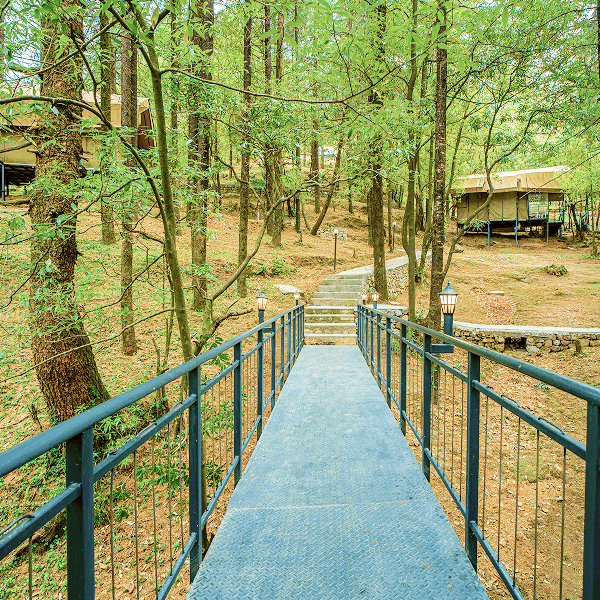
- Further along Hathipaon Road toward Cloud's End: The forest here is among the thickest near town. The rain view from these properties is mostly a forest one. Mist drifts through tall deodars. Water drips from high branches. Your world turns close, green and quiet, rather than wide and open. It feels different from the south-facing valley views, but it is just as atmospheric.
What Should You Look for in a Rain View Resort in Mussoorie?
When you compare properties for a monsoon rain view stay, these questions matter:
- Which way does the terrace or main viewing area face? South for the valley cloud. North for forest and ridge. West for sunset and evening light through the rain. Check this before you book. Do not rely on a single marketing photo.
- Can you use the terrace while it rains? For a rain view stay, you need a covered terrace, or a roof overhang that keeps the seats dry in heavy rain. An open terrace only works in the clear morning hours. Ask plainly whether the viewing area is sheltered.
- Is there a shared viewpoint on the property? At EBC, the team leads sunrise viewpoint walks, and Sir George Everest's House next door is a well-known viewpoint. The old house stands on a ridge with the Doon Valley on one side and the Aglar valley on the other. Ask whether these spots are open and safe to reach in monsoon weather.
- What can you see from the room itself? The best rain view stays give you a real view from inside the room, so the show goes on when the terrace is too wet. EBC's Zenith Luxury Cottage looks out on forest and mountains from its own private veranda. George's Den, the indoor lounge on the estate, has panoramic glass walls and can be reserved.
Why Is the Park Cafe Central to a Rain View Stay?
For guests at EBC Mussoorie in the monsoon, Park Café is more than a place to eat. It sits beside a meadow, on the spot where Sir George Everest once kept his stables. It gives you a place to sit, eat and watch the weather roll over the estate.
The café serves Garhwali dishes alongside Indian and continental food. Hot cocoa at dinner suits a wet evening well. In light rain you may want to sit near the open air. In heavy rain you will want shelter. Ask the team which tables stay dry and still face the view. An on-site café with the right seating matters more on a monsoon stay than at any other time of year. It is the practical reason, not just a dining one.
For more on the resort, read Hotelier India's feature on EBC. It covers the stay, the food and the outdoor activities.
How Should You Plan a Rain View Stay in Mussoorie?
- When in the monsoon to go: Late June and early July give you the freshest green, before the rain peaks. Late August into September brings clearer spells, lighter rain and hills that are still fully green. Mid-July to mid-August is the peak. It is the most dramatic time to look at, but the risk of road trouble is highest. Whenever you come, plan slow days on and around the estate rather than long treks.
- What to pack: A good rain jacket rather than an umbrella, since umbrellas are useless on windy ridge paths. Quick-dry clothes for morning walks. Waterproof shoes with good grip for wet forest paths. A compact camera, or a waterproof bag for your phone, if photos matter to you.
- Leech socks and trekking boots: This is the item most first-time monsoon visitors to the Garhwal hills skip, and then regret. Leeches are active on wet forest floors all through the Mussoorie monsoon. They are most common on shaded trails through thick deodar and oak, where the ground stays damp. They are harmless but unpleasant, and they latch on fast during a forest walk.
Leech socks are the simple fix. They are tightly woven cotton or canvas socks, worn over your normal socks. You pull them up over the calf and tuck them under your trouser cuffs. Leeches cannot get through that barrier. They cost very little and weigh almost nothing. You can buy them from trekking shops in Dehradun or online before your trip.
Pair them with proper trekking boots, not trail shoes, for any monsoon forest walk. Ankle-high boots with a waterproof lining and a deep-lug sole do three jobs at once. They keep water out on soaked ground. They grip wet rock and mud where trail shoes slide. And they cover the ankle, so the leech socks have something to tuck into. Low-cut shoes leave a gap at the ankle, and that is exactly where leeches strike.
If you will only walk the estate grounds and paved paths in light rain, trail shoes will do. For anything that goes deep into the forest, boots and leech socks are the right kit. That includes the Benog wildlife area trail and the lower Cloud's End paths. It is not overkill.
- Getting there: EBC Mussoorie is about 280 km from Delhi. In dry weather the drive takes 5.5 to 6.5 hours. In the monsoon, allow 7 to 8 hours. Landslides can close hill roads, so check live road updates and advisories before you set off, and keep a spare day in your plans. The Dehradun to Mussoorie road usually stays open through the monsoon, but it can be slow in heavy rain.
Common Questions
Frequently Asked Questions
Everything you need to know before booking your monsoon rain view getaway in Mussoorie.
Late June to early July, and late August to early September. These weeks give you a dramatic monsoon landscape with easier roads. Mid-July to mid-August is the most intense and most dramatic, but it carries the highest risk of road delays.
Face south to watch the cloud fill the valley. Face the forest, to the north or west, for close-up mist in the deodars. Both are special. Choose the one whose mood appeals to you more.
EBC sits on the western Mussoorie ridge, with both valley views and deep forest on the estate. Its 14 rooms face in different directions. Contact EBC Mussoorie directly to find the room whose monsoon view best suits you.
EBC stays open through the monsoon, and all its tents and cottages are weather-proofed. Still, contact the team to check road conditions for your dates. The main Mussoorie road is usually reliable, but confirm access to the estate before you travel. Keep your plans flexible in case of a landslide or road closure.
Not really. Monsoon cloud hides most of the night sky. The George Everest ridge is excellent for stars from October to November and from February to March, when the Milky Way shows on clear nights. In the monsoon, come for the rain and the mist instead.
Not in practice. At about 280 km each way, you need at least one night to make the trip worthwhile. Two nights in the monsoon let you see both the clear morning and the rainy afternoon and evening, which together make the rain view.